Your iPhone Takes Great Photos. So Why Do Real Estate Photographers Use Expensive Cameras?

10 real-world comparisons that reveal where smartphones shine, where professional mirrorless cameras pull ahead, and why the photographer still matters.

Today's iPhones can produce some remarkably good photographs. In fact, under the right conditions, you might have difficulty distinguishing an iPhone photograph from one taken with a professional mirrorless camera.
So why would a real estate photographer spend thousands of dollars on a camera, lenses, lighting equipment and tripods when there's already a capable camera sitting in their pocket?
It's a reasonable question, and the answer isn't quite as straightforward as you might think.
Let's compare the two across ten situations commonly encountered when photographing the inside of a home.

1. Window Pulls & Dynamic Range (Professional Grade Mirrorless Wins)
Mirrorless: Allows for manual exposure bracketing (taking multiple shots from very dark to very bright) and "flambient" (flash + ambient) photography. This is how high-end listings get perfectly exposed rooms while maintaining crystal-clear, colorful views out the windows.
iPhone: Relies entirely on computational Smart HDR. While impressive for consumer use, it often results in muddy, gray, or overexposed windows when the difference between dark interiors and bright sunlight is too extreme.

2. Ultra-Wide Lens Distortion (Professional Grade Mirrorless Wins)
Mirrorless: Professional rectilinear ultra-wide lenses (e.g., 14-24mm or 16-35mm) keep vertical lines (walls, doorframes) straight and maintain sharp focus edge-to-edge.
iPhone: The ultra-wide camera (13mm equivalent) suffers from noticeable barrel distortion and heavy corner softness. Software corrects some of this, but it often stretches furniture and makes rooms look unnaturally deep.

3. Lighting Control & Flash Sync (Professional Grade Mirrorless Wins)
Mirrorless: Can sync with powerful off-camera speedlights or strobes. Bouncing a flash off the ceiling ensures accurate colors and eliminates harsh shadows in poorly lit spaces.
iPhone: Cannot natively trigger professional off-camera flashes. You are strictly reliant on the home's practical lighting, natural light, or hauling in continuous LED video lights.

4. Turnaround Speed & Workflow (iPhone Wins)
iPhone: Unbeatable for sheer speed. You can shoot a 4K video walkthrough, take wide-angle photos, edit them in Lightroom Mobile, and upload them to a listing platform or social media before even leaving the driveway.
Mirrorless: Requires importing RAW files and heavy video files to a computer, manually blending bracketed shots or color grading, and then exporting.
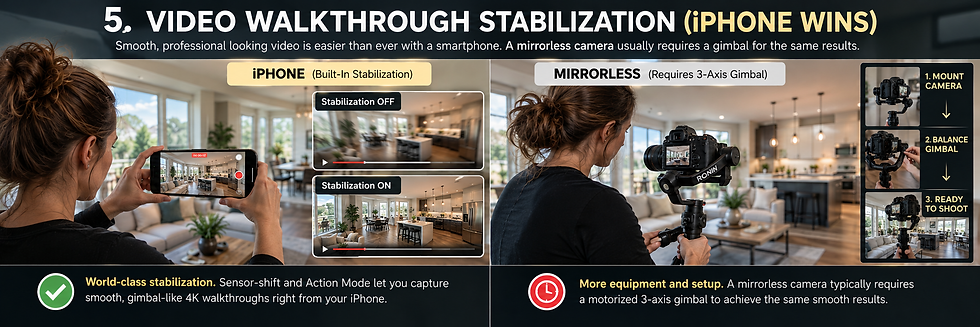
5. Video Walkthrough Stabilization (iPhone Wins)
iPhone: Features world-class internal stabilization (Sensor-shift and Action Mode). You can achieve incredibly smooth, gimbal-like 4K video walkthroughs just by holding the phone steadily in your hands.
Mirrorless: Generally requires mounting the camera to a heavy, motorized 3-axis gimbal (like a DJI Ronin) to achieve perfectly smooth walking shots, adding significant setup time and weight. However,

6. Mixed Lighting White Balance (Professional Grade Mirrorless Wins)
Mirrorless: Shooting in true RAW allows you to easily correct the severe color clashes caused by warm tungsten interior bulbs mixing with cool blue daylight coming through windows.
iPhone: The automated white balance often struggles with mixed lighting, resulting in yellow ceilings or blue-tinted floors. While Apple ProRAW helps, the phone bakes in a lot of color decisions that are hard to undo cleanly.

7. Depth of Field Control (Tie - Context Dependent)
iPhone: Ironically, the small sensor size is a benefit here. It naturally keeps almost everything from the foreground coffee table to the back wall in sharp focus, which is exactly what real estate photos need.
Mirrorless: The large full-frame sensor naturally creates background blur. To keep the whole room in focus, you must "stop down" the lens to f/8 or f/11, which lets in less light and absolutely requires a sturdy tripod.

8. Low-Light Sensor Performance (Professional Grade Mirrorless Wins)
Mirrorless: Full-frame sensors capture vastly more light. In a dim basement or a room with closed blinds, a mirrorless camera on a tripod will capture a pristine, noise-free image.
iPhone: In dark rooms, the iPhone will artificially brighten the image using software, which often results in a "watercolor effect," grainy noise, and loss of texture on furniture and carpets.

9. Resolution & Cropping Power (Professional Grade Mirrorless Wins)
Mirrorless: Modern sensors (24MP to 60+MP) paired with high-quality glass resolve fine details perfectly. You can crop heavily into a shot to highlight a specific architectural detail without losing quality.
iPhone: While newer iPhones boast 48MP main sensors, the ultra-wide lens used for most real estate shots often defaults to lower resolutions or uses digital upscaling, leaving fine details (like wood grain or fabric texture) looking mushy when zoomed in.

10. Perceived Professionalism (Professional Grade Mirrorless Wins)
Mirrorless: Real estate agents and home sellers expect to see professional gear when they pay for media. A tripod-mounted mirrorless camera signals professional value and justifies a high rate.
iPhone: Showing up to shoot a million-dollar listing with the same device the seller has in their pocket can psychologically devalue the service, regardless of the final output quality.


Comments